Drag Queen Rebbetzin
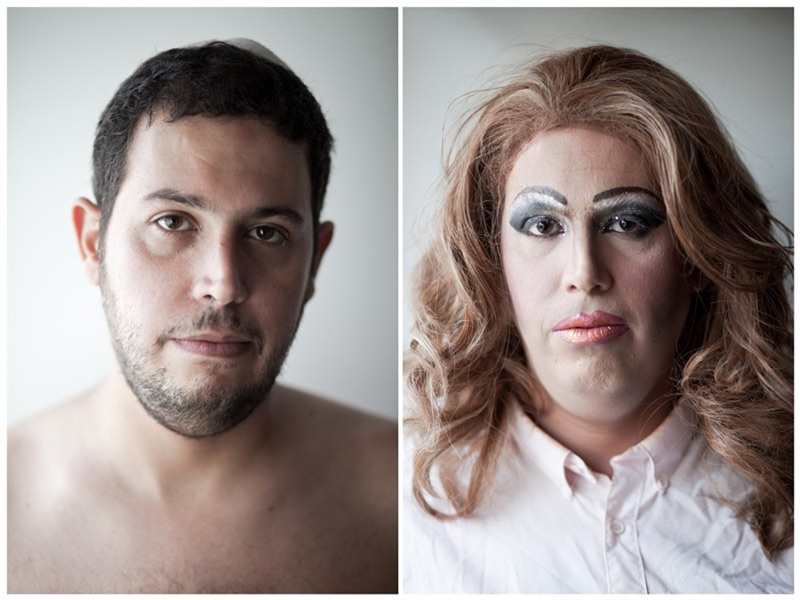
[Photo Oded Balilty.]
JERUSALEM — […] It has been a long and agonizing metamorphosis for Hadar, 34, from being a conflicted Orthodox Jew to a proud religious gay man — and drag queen. Most Orthodox Jewish gay men, like those in other conservative religious communities around the world, are compelled to make a devil’s bargain: marry a woman to remain in their tight-knit religious community, or abandon their family, community and religion to live openly gay lives.
But while Orthodox Judaism generally condemns homosexuality, there is a growing group of devout gay Jews in Israel unwilling to abandon their faith and demanding a place in the religious community.
“As much as I fled it, the heavens made it clear to me that that’s who I am,” Hadar said. He is marching Thursday — out of costume — in Jerusalem’s annual gay pride parade.
Hadar, a telemarketer by day, has taken the gay Orthodox struggle from the synagogue to the stage, beginning to perform as one of Israel’s few religious drag queens. His drag persona is that of a rebbetzin, a female rabbinic advisor — a wholesome guise that stands out among the sarcastic and raunchy cast of characters on Israel’s drag queen circuit.
“She blesses, she loves everyone,” said Hadar of his alter-ego, Rebbetzin Malka Falsche. The stage name is a playful take on a Hebrew word meaning “queen” and Hebrew slang for “fake.” Her philosophy, and Hadar’s, draws from the teachings of the Breslov Hasidic stream of ultra-Orthodox Judaism: embrace life’s vicissitudes with joy.
“Usually drag queens are gruff. I decided that I wanted to be happy, entertain people, perform mitzvoth,” or religious deeds, he said.
[…] “I wanted to take the path that (God) commanded of us. I didn’t see any other option,” Hadar said. “I thought the marriage would make me straight and I would be cured.”
He felt distressed while intimate with his wife, and wouldn’t tell her why. She demanded a divorce. She later gave birth to their daughter, who is 11 years old today. His ex-wife still refuses to let them meet.
After Hadar’s own sister met a similar fate — she divorced her husband because he was gay — homophobic conversation erupted around the Hadar family dinner table. Hadar’s brother reprimanded the family, who had also become religious, by simply asking, “Are gays not human beings?”
His brother had stood up for Hadar without even knowing it.
A few months later, in 2010, Hadar mustered up the nerve to march in Tel Aviv’s gay pride parade. When he returned home that Sabbath eve, he finally told his mother he was gay. “I thought it would be the blackest day in my life,” Hadar said, but she accepted him.
As a practicing Orthodox Jew, it hasn’t been easy for Hadar to integrate into mainstream gay life. He used to tuck his shoulder-length religious side locks under a cap to fit in at bars. Eventually, he sheared his side locks and trimmed his beard to thin stubble to increase his luck on the dating scene.
He’s still looking for love. But this year, Hadar found acceptance — and self-expression — at Drag Yourself, a Tel Aviv school offering 10-month courses for budding drag performers. Students learn how to teeter on high heels, apply false eyelashes and fashion their own drag personas. Hadar, still a beginner, graduates next month.
The drag school, much like Israel’s gay community itself, offers a rare opportunity for Israelis to interact with others from disparate and sometimes warring sectors of society. The school may be the only place where a Jewish settler, a lapsed ultra-Orthodox Jew, an Arab-Israeli and Israeli soldiers have stuffed their bras together.
Of all the students in his class, Hadar was the only one to show up wearing a yarmulke.
“I think it’s fabulous,” said Gil Naveh, a veteran Israeli drag queen and director of the school, as he painted Hadar’s lips apple-red before his midnight debut at a Jerusalem gay bar. “He stays true to who he is.”
___
Online: Rebbetzin Malka Falsche, Hadar’s drag queen persona: www.facebook.com/rabanitmf
Associated Press, Daniel Estrin: “Israeli Jew is devout gay drag queen.”